


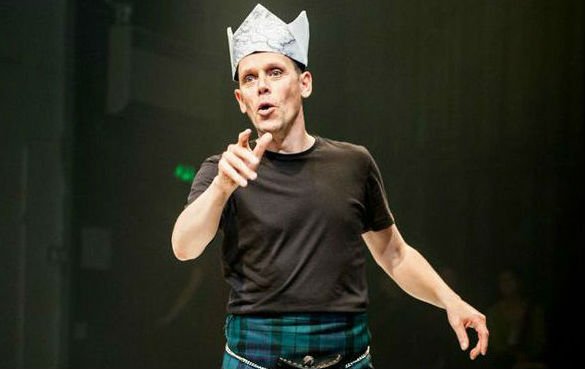
We’ve been talking to… Andy Cannon
At Open Road we’re passionate about storytelling and giving people voice. We believe that understanding the past can inspire change in the here and now and help build a better future. We regularly have inspiring conversations with remarkable people through our work who are using storytelling to drive change. Through ‘we’ve been talking to’ we share these conversations – the learning and the inspiration. Let us know if there is anyone we should be talking to.
When you strip away the noise, people are generally thoughtful and decent. For me, that’s where the hope lies, in real human interaction and shared experiences.
What are you currently working on ?
Alongside moving from Leith to the Moray Coast, which has been a creative shift in itself, I’m working on Last People on Earth. At its simplest it’s about the almost legendary Battle of Mons Graupius. I say “legendary” because we don’t actually know where it took place, possibly Bennachie, possibly elsewhere and it likely happened around AD 83 to 85.
But the project isn’t really about the battle. It’s about what you might call, cautiously, the “first Scot”: a Caledonian leader who appears in recorded history. That term is anachronistic, of course, but it captures the idea.
What draws me in is the speech attributed to him, delivered to a gathering of tribes before they faced the Romans. It was written down by the Roman historian Tacitus – so it’s as much a Roman story as a Caledonian one. In fact, it’s often read as a critique of Rome itself, contrasting imperial excess with the perceived integrity of these northern tribes.
It’s also famed for a line that has echoed down the centuries: that the Romans “make a desert and call it peace.” It’s been quoted again and again to describe later conflicts, even very recently, I think because it captures something stark about the language of power and conquest.
What’s always struck me about the speech is how I first came across it. I was working through a broad, almost complete history of Scotland and I found myself lingering on this one moment far longer than expected. It felt, in some ways, as significant as battles like Battle of Bannockburn or Battle of Culloden – or at least as resonant.
But I’ve become increasingly wary of words like “important.” What does that really mean in history? I’m more conscious now that the way we talk about the past is always shaping it, always carrying an opinion. And I’m less interested in imposing a judgement than in exploring the story itself, sitting with its ambiguities and seeing what it reveals.
The other key element of The Last People on Earth is working with local choirs to create a kind of chorus. We will be developing songs with them in advance so that, when we arrive at a community performance venue, we can do a short workshop or rehearsal to bring them into the performance.
They’ll still be in the audience, but they’ll also become part of the piece itself.
What story from the past do you think it’s important to preserve
I think that’s a really interesting question. I love it, because I’m aware how much my answer might have changed over time. If you’d asked me 10 or 15 years ago, I probably would have given different answers but in some ways those earlier ones are still there.
There are certain stories from literature that just stay with you. They keep resurfacing. They’re retold and they almost function like cautionary tales. I was first really struck by that when I read Animal Farm as a child, probably in primary seven. That idea of a political fable, a warning story really stayed with me.
And I think I’ve always been drawn to that kind of narrative structure. Even now, I find myself returning to stories that work on that level.
One that I keep coming back to is Macbeth. I’m slightly obsessed with the play, the way it operates as both history and prophecy, and the way it keeps shifting depending on how you read it.
I love what we usually think of as a Shakespeare story, but in the case of Macbeth, it actually comes from Hector Boece, an Aberdonian historian from the 16th century. He compiled earlier sources and traditions and that’s where elements like the witches originate.
Another story I return to is Frankenstein. Again, they’re all essentially cautionary tales, but there’s something in Frankenstein that keeps opening up as I get older. That might sound a bit sentimental, but I find I get something different from these stories each time I return to them. Every five years or so, they shift.
That’s what I love about really good stories: they don’t stay fixed. They change as you change. You see different things in them depending on where you are in life.
And even in children’s literature, I’ve always loved Pinocchio. When I first read it as a child, it was simply a story, but as an adult you start to see how dark and layered it actually is. When I enjoyed Pinocchio as a child, I saw it entirely from Pinocchio’s point of view. Then one day I was watching a stage adaptation in Newcastle, and I suddenly realised I was Giuseppe. I found myself wanting to say to Pinocchio, “Don’t run away. I love you. Don’t worry.”
It was a very simple shift, but quite profound. And I think it’s something that happens more as you get older, you start to see stories from completely different positions. The emotional alignment changes.
So, I’d probably say Animal Farm, Macbeth, Frankenstein and Pinocchio are the kinds of stories I keep returning to. They feel like works you could almost put in a box and preserve for 500 years, just to see how they continue to speak to people in the future.
And I’ve also found myself thinking more and more about nature, and the changing of the seasons. I don’t know exactly what the story is there yet, but I’m less interested in a linear idea of time – an arrow moving forward- and more in cycles, return and repetition. I find myself increasingly drawn to that idea, which appears in many cultures.
A book I probably should have read years ago is The Living Mountain by Nan Shepherd. It’s brilliant. There’s a line in it I came across recently where she writes: “However often I walk in them, these hills hold astonishment for me. There is no getting accustomed to them.”
I love that idea. It speaks to why we return to certain places, why we have favourite walks and why we go out into the landscape again and again. It changes with the seasons and yet it never becomes familiar in a reductive way. I wouldn’t necessarily call it a story, but I think of it almost as a kind of handbook. The Living Mountain captures something essential about attention, nature and return.
What is on your mind right now?
I’m thinking a lot about my move to Aberdeenshire and the opportunities it opens up both personally and creatively. Working in the arts, my friends and colleagues are often the same people and that sense of shared exploration and collaboration is really energising. I’m also looking forward to being in a new landscape, experiencing the changing seasons and discovering new places.
At the same time, I’m quite concerned about the wider world, particularly the direction of politics. There’s a growing sense of division, where it feels like people are pushed into opposing sides and that worries me. I also notice a lot of underlying anger in society, even in small everyday things. I don’t judge it as much as I try to understand where it’s coming from, it feels like a reflection of uncertainty about the future.
Looking three years into the future, what changes would you like to see?
I’d like to see the beginnings of a shift in how we think about society and the economy. Not a complete transformation overnight, but a growing recognition that the current model isn’t really working for many people.
Ideally, there would be momentum toward a more caring economy, one that values people, community and essential work more than pure consumption. At the moment it can feel like we’re maintaining systems that don’t quite make sense anymore. In three years I’d hope we’re at least moving toward new ways of thinking about how we live and support each other.
Is there anything else you’d like to add?
One thing that feels quite urgent is the influence of social media and celebrity culture. They shape how we see each other and even how we engage with politics, often prioritising personality over substance. That can distort how decisions are made and how people relate to one another. But on a positive note, I do believe that when people meet face-to-face there’s still a lot of kindness and connection. When you strip away the noise, people are generally thoughtful and decent. For me, that’s where the hope lies, in real human interaction and shared experiences.