


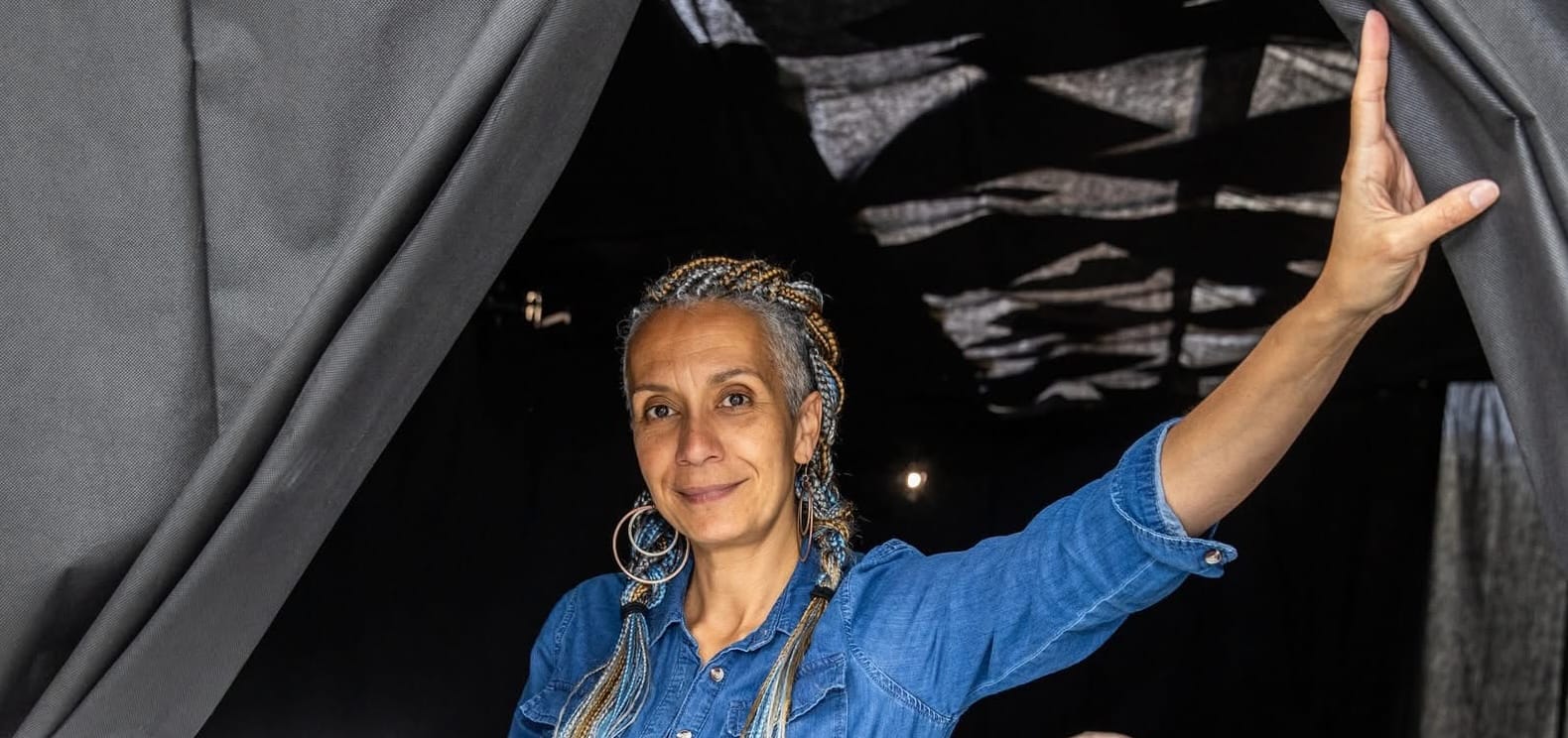
We’ve been talking to… Carla Angus
At Open Road we’re passionate about storytelling and giving people voice. We believe that understanding the past can inspire change in the here and now and help build a better future. We regularly have inspiring conversations with remarkable people through our work who are using storytelling to drive change. Through ‘we’ve been talking to’ we share these conversations – the learning and the inspiration. Let us know if there is anyone we should be talking to.
..a lot of my practice is about finding small, often hidden stories and making connections between them – what I sometimes describe as “making connections between things that may otherwise be hidden.”
Tell us about who you are and the work you are currently doing.
I’m a visual artist with a background in theatre design, and I’m really interested in stories, heritage, and relationships – particularly the stories held in objects, places and people. I tend to think in three dimensions, so my work often takes the form of objects and installations rather than flat works on walls. The materials I use are led by the story or conversation I’m exploring. They might be textiles, ceramics, found objects or whatever feels right for that particular project.
For about 15 years my husband Bryan (also an artist) and I ran an arts retreat on the coast in Aberdeenshire, where people came for residential weeks to make work, take time out and reconnect with their creativity. In parallel, I worked for around 16 years for Aberdeenshire Council’s arts team, linking communities and creatives with a strong focus on wellbeing through creativity.
A few years ago, I completed a MA in Fine Art at Gray’s School of Art which helped me re-focus on my own visual art practice.
Right now, I’m involved in several projects, and I am excited about joining the Open Road team for Last People on Earth, where I am picking up and developing some of the design work initially started by my husband, and reconnecting with performance related design. I am also working with Shetland Museum and Archives and the Zya Community on a commission with six other artists called Gathered Here, responding to their collections and the wider culture of Shetland. I’m also developing work for a forthcoming exhibition in Glasgow this autumn.
I’m originally from London and over the years I’ve lived in Nottingham, Bristol, Aberdeen and now Banff in Aberdeenshire, where we’ve been for 24 years. All of those moves, people and places feed into the stories I’m drawn to in my work.
We’re living in a time of rapid change. What story from the past do you think it’s important to preserve?
Rather than a single story, I think it’s crucial to preserve the many stories of human movement, the long, complex history of migration, immigration and emigration across the planet.
These are stories that run from things like the Romans in Britain right through to the Windrush generation and all the movements of people in between. They speak to our human need to explore, to seek safety and security and to build new lives. They illuminate how different knowledges and cultures blend and reshape one another over time.
I’m particularly drawn to these histories because of my own mixed heritage – Scottish, English, Irish, Guyanese and Portuguese. Some of these stories are uplifting, some are painful, but all of them are essential if we’re to understand how our societies have become what they are today. Preserving and acknowledging these migration stories feels vital.
What’s on your mind right now?
What’s most on my mind is the growing polarisation of opinion and how quickly people are pushed into “us and them” positions, especially through social media. The speed at which people are expected to react and the speed at which comments escalate, leaves very little room for reflection, nuance or empathy.
People say things online that they would never say face to face and that can fracture relationships within families, communities and wider society. I completely believe in people’s right to hold different views, variety is what makes life interesting, but I’m worried by how quickly difference is turned into division.
I think some of this is rooted in a natural, almost tribal instinct to protect “our own.” The challenge is whether we can lift ourselves a bit above that instinct and choose to respect one another’s differences instead of shutting each other down.
As a parent of two adult children, I’m conscious of the world they’re stepping into with all of this swirling around them. That’s a big part of what’s on my mind.
Looking three years into the future, what changes would you like to see?
In three years’ time, I’d love to see a world with more connectedness, empathy and respect between people.
One idea my husband Bryan and I talked about was that instead of mandatory military service, everyone might do a period of community service outside their own community. Spending time living and working in a context that’s unfamiliar would give people a deeper sense of how others live. This might help us become less fearful of difference and more understanding of each other.
I’d also like to see more people and communities taking responsibility for their local area, especially with local councils having fewer resources and facing huge demands in social care, education and support services.
Linked to that is the importance of “third spaces”, places that are not home and not work, where people can be safely together without needing to buy something or belong to a particular group. When I was younger, there were more community centres and similar spaces. Now, libraries often perform some of that role. The pandemic really highlighted how essential it is to have safe, accessible spaces outside the home and also how unequal access to space can be.
So, in short: more empathy, more shared responsibility and more genuine community spaces.
Is there anything else you’d like to share?
I was really struck by reading Mara’s interview about climate change and particularly by the way her organisation, Aberdeen Performing Arts, has created space within staff roles to engage meaningfully with that issue.
I find it inspiring when organisations support their staff and volunteers to work on things that are socially and environmentally crucial, whether that’s climate change, safer communities or other urgent challenges. I’d love to see more organisations building that kind of engagement into how they operate, rather than treating it as something people have to squeeze in around the edges of their working lives.
More personally, I’d say that a lot of my practice is about finding small, often hidden stories and making connections between them – what I sometimes describe as “making connections between things that may otherwise be hidden.” I’m excited to keep doing that through projects like the Shetland commission and The Last People on Earth, and I’m always open to conversations with people who are interested in these themes.