


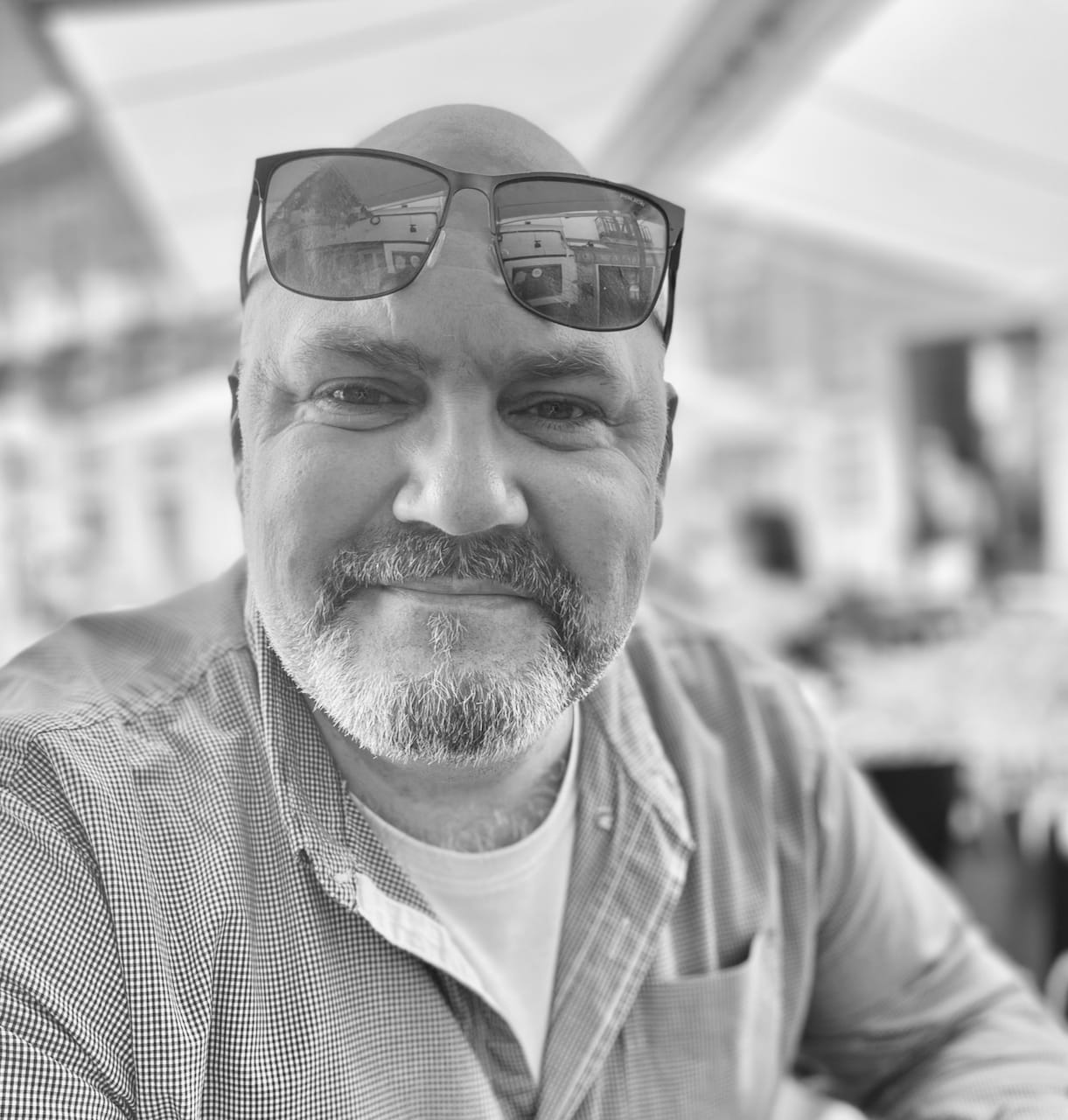
We’ve been talking to… Ian Grosz
At Open Road we’re passionate about storytelling and giving people voice. We believe that understanding the past can inspire change in the here and now and help build a better future. We regularly have inspiring conversations with remarkable people through our work who are using storytelling to drive change. Through ‘we’ve been talking to’ we share these conversations – the learning and the inspiration. Let us know if there is anyone we should be talking to.
I’m interested in history because it informs the present and can help guide how we respond to the future. I’m not interested in history for history’s sake, or heritage for heritage’s sake. What interests me are the stories they tell us about who we are and how we got here.
Tell us about who you are and the work you are currently doing?
I think we’re all constantly changing, and I’ve been through a pretty significant change personally and professionally over the last five to ten years.
I work in the heritage sector now, with a background in creative writing and participatory practice. It’s very much a second career – a second life, really. Before this, I flew helicopters for a living for twenty years. I eventually reached a point where I’d become increasingly disaffected with that career and knew I needed to make a change.
I went back to university and, through that, became involved in creative writing, running creative writing sessions, community engagement and, eventually, a couple of large heritage projects. That experience gradually brought together the things I was becoming most interested in: creativity, communities, participation and heritage.
I’m now a Heritage Activities Project Officer for Aberdeen City Council, coordinating a programme of cultural and heritage activities as part of a five-year, council-led project funded by Historic Environment Scotland and the National Lottery Heritage Fund.
The project has three main strands. The first is capital investment in the city’s historic buildings and environment. The second is a training programme supporting people to develop traditional building and conservation skills. And the third is the heritage activities programme, which is the part I work on.
That programme is very much community focused. We bring cultural and heritage activities into communities through creative workshops, story gathering projects, performances, community grants and other opportunities for people to engage with the heritage around them.
It’s a great fit for me because, although it sits within the heritage sector, it’s really grounded in community engagement, co-production and co-design. After making quite a late career change, it’s been great to find myself doing something that brings together heritage, creativity and working with communities.
In many ways, I think that’s what this second chapter of my career has been about — finding a way to combine the things I care about and using them to create opportunities for other people to connect with their own communities, stories and heritage.
We’re living in a time of rapid change. What story from the past do you think is important to preserve?
I think that wherever you live, if you look closely at the place around you, you’ll find stories from the past that speak directly to the present.
There’s a phrase from the Swedish writer Sven Lindqvist: “Dig where you stand.” He encouraged workers to explore the history of their own workplaces as a way of understanding exploitation and creating social change. I think that principle can be applied much more broadly.
I should also acknowledge the work that TRACS and Mairi McFadyen have done in taking that principle and applying it creatively in Scotland. Mairi is an ethnologist and creative practitioner, and she has been involved in developing Dig Where You Stand resources and programmes, first through TRACS and the Dandelion Project and more recently through Fèis Rois. The approach is about connecting people with the cultural memory of the places where they live — exploring local history, traditions, stories, ecology and community knowledge, and then asking what those things might mean to us now.
That really resonates with me because I think heritage is most powerful when it helps us understand where we are, rather than simply telling us where we’ve come from.
If you look around Aberdeenshire, there’s a very visible landscape of the past that can tell us something about what is happening today. The area is famous for its recumbent stone circles, hill forts and Pictish heritage.
The Neolithic period, for example, was a time of relatively stable and mild climate. The stone circles that appeared across Britain and the North Atlantic from around 4,500 BC onwards represent a society with shared beliefs, practices and technologies. These monuments were deeply connected to the seasons, ancestors, the moon, death and rebirth.
Then the climate changed. Britain became cooler and wetter, farming became more difficult, crops began to fail and people had to adapt. By the Iron Age, we see a very different landscape, with people retreating to hill forts and settlements becoming more defensive. There was still trade and exchange over huge distances, but the landscape increasingly speaks of protection, territorialism and competition for resources.
That feels very relevant to the present. As international cooperation begins to break down, the climate is changing rapidly and resources such as food, water and energy are under increasing pressure, we seem to be retreating into our own metaphorical hill forts — nation states becoming more defensive and protectionist.
What worries me is that insecurity and fear can bring out an innate fear of “the other”. We see that in reactions to migration and in the desire to protect our culture, resources and borders. I worry that, as climate change puts more of the systems we rely on under pressure, we could be in danger of losing some of our humanity. But I don’t think that means we should give up. If anything Dig Where you Stand is a good place to start.
When I look at what’s happening in communities, I see a lot of positive responses to the climate crisis, biodiversity loss, inequality and the energy crisis. Communities are developing their own solutions and building resilience. The work around Dig Where You Stand is a good example of that approach: starting with the knowledge, stories, relationships and resources that already exist within a place, and using them as a starting point for creativity and connection.
I think if we’re going to adapt to the challenges we face, it will begin with where we are and spread from there. Perhaps the important story to preserve isn’t one particular story at all, but the idea that the places we live in are full of knowledge – and that by paying attention to that knowledge, we might find ways of responding to the future together.
What’s on your mind right now?
On an everyday level, I’m thinking a lot about maintaining space for creativity and for connecting with nature.
My wife and I have a community allotment nearby and, interestingly, there’s a hill fort visible from it. So I’m constantly reminded of that landscape and its history.
With a busy job and a busy life, the allotment gives me a chance to connect with the seasons and step outside that constant busyness. At this time of year, there’s a real sense of moving from summer into autumn, preparing the ground for the next phase and simply getting your hands in the soil. It’s a lovely antidote to everything else that’s going on.
I’m also trying to create space to return to my writing practice. My PhD was in creative writing, and my work has always been rooted in landscape and place. My PhD was a form of narrative non-fiction exploring landscape, our senses of place and my own relationship with the places I live in.
That work also looked at the people who inhabit those landscapes and how places influence them. So my writing naturally brings together landscape, heritage, history and the stories of the people who live in those places.
Looking three years into the future, what changes would you like to see?
I’d like to see Aberdeen really move beyond the idea of itself simply as an oil city and become confident about where it is going next.
Aberdeen has a very strong sense of identity, but it is going through a period of significant change. It needs to be able to acknowledge and celebrate its oil heritage without becoming defined by it. That history is something to understand and celebrate, but not something to cling to. I’d like to see the city draw on some of its other stories and start to build a confident sense of what its future could look like.
I think there are parallels with my own experience of change. There’s an uncertain period in between where you’re trying to work out who you are and where you’re going, and I think Aberdeen is in that phase at the moment.
I’d also like to see nature and biodiversity woven much more deeply into policy and planning, with a recognition at national and international level that nature is the fabric of life and therefore fundamental to our economy, our communities and everything else.
I’d like to see Scotland become the first rewilding nation, and I’d welcome greater political focus on nature. I’d also like to see Scotland commit fully to a greener energy system and move away from its dependence on oil.
But importantly, I’d like that renewable energy future to be community-based rather than simply corporate. If the wealth generated by renewable energy stayed within communities rather than being concentrated in the hands of large corporations, that could create a much more positive transition.
There are huge challenges involved, and perhaps all of that is too much to achieve in three years, but I’d like to see us clearly moving in that direction.
Is there anything else you’d like to share?
I’m interested in history because it informs the present and can help guide how we respond to the future. I’m not interested in history for history’s sake, or heritage for heritage’s sake. What interests me are the stories they tell us about who we are and how we got here.
I don’t think we should freeze places in the past. Change is important and inevitable. But preserving aspects of the past reminds us of the stories we tell ourselves about who we are, while also giving us the opportunity to think about who we want to become.
I’d also like to give a mention to Paperboats Writers, a collective of writers focused on nature and the environment during this particularly challenging time. I’m on the periphery of the collective as a writer, and there are some wonderful writers involved.
I previously hosted and co-produced a podcast for Paperboats, creating ten episodes in collaboration with Station House Media Unit (shmu), exploring writing and ideas around nature, climate and the environment. Paperboats also produces a twice-yearly zine featuring writing on nature, climate and the environment.
Ultimately, I think that connection between place, heritage, creativity and community is really important. The past can help us understand the present, but it should also help us imagine a better future.
For further information:
https://tracscotland.org/the-dandelion-project-dig-where-you-stand-resource