


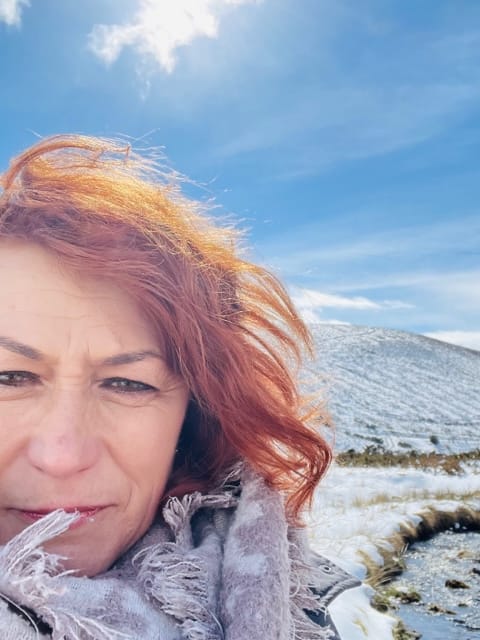
We’ve been talking to… Lesley Anne Rose
At Open Road we’re passionate about storytelling and giving people voice. We believe that understanding the past can inspire change in the here and now and help build a better future. We regularly have inspiring conversations with remarkable people through our work who are using storytelling to drive change. Through ‘we’ve been talking to’ we share these conversations – the learning and the inspiration. Let us know if there is anyone we should be talking to.
If we want people to participate, to care, or to feel that they have a stake in something, we need to tell stories they see themselves in and are inspired by.
Tell us about who you are and the work you are currently doing?
I am the co-founder of Open Road, a writer and creative producer with a passion for people and place. My background is as a travel writer, and my last book was about Scotland – its history, culture, heritage and present day. I’m currently working on a book about the North East, which is full of rich and often untold history and heritage.
At the moment, with Open Road, we’re excited to be bringing Andy Canon’s The Last People on Earth to the stage. It’s wonderful to have a story rooted in North East Scotland being told on local stages as well as nationally. We’ll be taking the show to the Scottish International Storytelling Festival in Edinburgh in October and to Insch and Inverurie, alongside our launch at Fittie Community Hall on Saturday 3 October.
It’s exciting to see a professionally produced North East story heading to the Central Belt. Usually, it’s the other way around – theatre from the Central Belt comes to us. So it’s great that we’re taking our stories to other audiences and, importantly, giving people in the North East the opportunity to see their own stories represented on stage.
That connects closely with our wider work around culture and place planning. We believe culture should be at the heart of our communities, and that communities should have ownership of their culture, with genuine opportunities to access and participate in it. Culture shouldn’t be something that is only available if you live in a city centre; it should be part of everybody’s lives.
We’ve also launched the Culture in Climate Action: Integrating culture into 20-minute neighbourhoods toolkit which has been co-authored by Open Road, Culture for Carbon Scotland, North Edinburgh Arts, the Ramboll Agency and Collective Architecture.
Scotland is a world leader when it comes to place planning, but one thing that has been noticeably absent is culture. Much of the work we’ve been doing, in partnership with other organisations, is about addressing that gap and taking the next step towards Scotland being a true world leader in place planning.
We’re living in a time of rapid change. What story from the past do you think it’s important to preserve?
To be slightly blasé about it, I think all stories from the past are important. It’s vital that we know our history because it’s what has brought us here and shaped who we are – whether that’s our family history, our community history or our national history.
Whoever owns our stories and our culture owns us, so we need to understand what those stories are. And that means people’s history, not just stories about royalty and wars. We need to preserve the everyday histories of our communities: how people farmed, how they mended things, the rebellions they were part of, and the ways in which people lived and connected with one another.
Those stories also often articulate our connection with the natural world, which is something that can be left out of traditional accounts of history. There is a direct connection between the loss of cultural diversity and the loss of biodiversity, so understanding and preserving our cultural heritage is intrinsically linked to understanding and protecting our environment.
It’s also important to think about how accessible our stories are. We can all make podcasts, blogs and Substacks now, and access to stories is much easier than it has ever been. But I still think written stories are incredibly important because we know they can be preserved and passed down through generations. We don’t know what will happen to all of our digital forms of storytelling in the future, or whether they will disappear. So we need to make sure our stories are recorded and written down as well.
Looking three years into the future, what changes would you like to see?
I’d like to see a real shift in the priority given to culture within place planning. There are some practical things that could help make that happen.
I’d like to see the creation of stronger networks and partnerships around this work, alongside greater knowledge and understanding of place planning within Community Councils and Community Development Trusts. Communities need to be equipped to understand and influence the development of the places they live in.
This work also needs to be supported by long-term funding. Local authorities need support to build their capacity to do this properly and to make culture a meaningful part of place-based work, rather than something that is added on at the end.
We also need to break down the departmental silos within local authorities. Transport, planning, culture, health and other areas all have a role to play in creating successful places, and they need to be able to work much more closely together.
I’d like to see the profile of culture raised within place-based working and recognised as something fundamental to the resilience, wellbeing and identity of communities.
And, at the heart of all of this, there is the power of storytelling. Communities have their own stories, histories and identities, and that storytelling should be enabled and supported through place planning.
What’s on your mind right now?
Culture in communities is very much on my mind. We’ve just launched the Culture in Climate Action: Integrating culture into 20-minute neighbourhoods toolkit, and it’s exciting to see all of the work we’ve been doing through Open Road over the years in communities contributing to something that is now becoming part of a wider national conversation.
We’ve worked with lots of partners and there is a huge amount of great work happening across Scotland, but I think getting to this stage has really impressed upon me just how much potential there is. It has reinforced how important it is for communities to own their culture and have genuine access to it.
I also want to broaden people’s understanding of what culture in communities can mean. Sometimes culture is dismissed as a few art classes, a singalong or the occasional film night, and that really does it a disservice. Culture can be much more fundamental than that. It can be about identity, connection, confidence, belonging and the way communities understand and express themselves.
A great example came from a visit I made to Memphis a few years ago. I’d got lost and stopped at Robert R. Church Park, on the corner of Fourth and Beale Street, to get my bearings. While I was trying to work out where I was, I started reading the information boards around the edge of the park.
It’s a beautiful park and an inner-city oasis of trees and neat grass, and it remains an important part of Memphis’s African-American community. During segregation, cultural facilities for the African-American community were not provided by the City of Memphis. The park was therefore funded by Robert Reed Church and opened in 1899. At its heart was an auditorium, which has since been demolished, but which became an important centre for culture within the community. The auditorium also hosted world leaders and had its own house orchestra, led by W. C. Handy, who is widely known as the “Father of the Blues”.
What struck me about that story was the sheer ambition of it. This wasn’t culture as an optional extra. It was a community creating a place for itself – somewhere to gather, celebrate, perform, share ideas and develop its own cultural identity.
That’s a real inspiration when I think about the potential of culture in communities today. We should be thinking much more ambitiously about what culture can do and what communities can create when they have ownership of it.
For Open Road, our focus is quite simple: we tell stories and we can help you tell yours.
As well as projects like The Last People on Earth, we offer a storytelling-centred approach to communications, from website copy and press releases to people-focused case studies.
We can also turn a business strategy into a story that employees and partners want to be part of. And we can help tell the story of your company, project, product or organisation in a way that makes people want to lean in and find out more.
I wrote a blog a few years ago called Let Me Tell You a Strategy…, which explores how storytelling can help bring strategy to life – particularly how thinking about strategy as a story can help people understand the journey of change and, importantly, see where they fit within it.
For me, whether we’re talking about communities, organisations or businesses, it comes back to the same thing: people connect with stories. If we want people to participate, to care, or to feel that they have a stake in something, we need to tell stories they see themselves in and are inspired by.
For more information
https://lesleyannerose.co.uk/2020/10/11/let-me-tell-you-a-strategy/
https://www.openroadltd.com/projects/the-last-people-on-earth/