



We’ve been talking to… Esther & Anu
“Just as red roofs are peppered across today’s skyline, fragments of history are scattered across the city.” Anu, a product designer
At Open Road we’re passionate about storytelling and giving people voice. We believe that understanding the past can inspire change in the here and now and help build a better future. We regularly have inspiring conversations with remarkable people through our work who are using storytelling to drive change. Through ‘we’ve been talking to’ we share these conversations – the learning and the inspiration. Let us know if there is anyone we should be talking to.
Tell us about who you are and the work you are currently doing?
Esther: We’re Anu and Esther, a product designer and an artist living and working in Aberdeen.
I’m a contemporary artist working primarily with sculpture and land art. I’m fascinated by the relationship between landscape and the built environment, how places shape us and how their psychogeography lingers beneath the surface. Recent projects have taken me along the River Dee, the Aberdeen coastline and across to the Isle of Eigg.
Anu: I’m a product designer working mainly in software, with a particular interest in how meaning becomes embedded in material artefacts and the stories objects carry.
Lately, we’ve been exploring Aberdeen’s multiple identities, the versions people speak about openly and the ones that often go unsaid. Before I moved here from London some friends told me not to come. Where they saw oil, I saw transition. Where they saw granite, I saw a city in bloom — cherry blossoms hinting at historic trade links as far as Japan.
Even within the city, opinions vary. Aberdeen is often reduced to stereotypes, but if you trace its history or see it across seasons, you find countless tones and facets.
Esther: Our current project – The Red Tile Project – reimagines one aspect of Aberdeen’s history. Pan tiles were once shipped into the harbour as ballast and discarded along the beach. Locals collected and reused them, eventually producing their own tiles and bricks to build the growing city. Early maps from the 15th and 16th centuries show Aberdeen as red.
Traces of that history remain, particularly in Old Aberdeen, where red roofs still peek through the granite. Through our combined practices we’ve created a series of works celebrating this overlooked story. We hope our March exhibition encourages alternative narratives of the city to emerge.

We became interested after noticing red tiles scattered across the city, something that felt out of place, yet turned out to be foundational. You often hear about fishing and oil, but what about the other industries? The quieter stories?
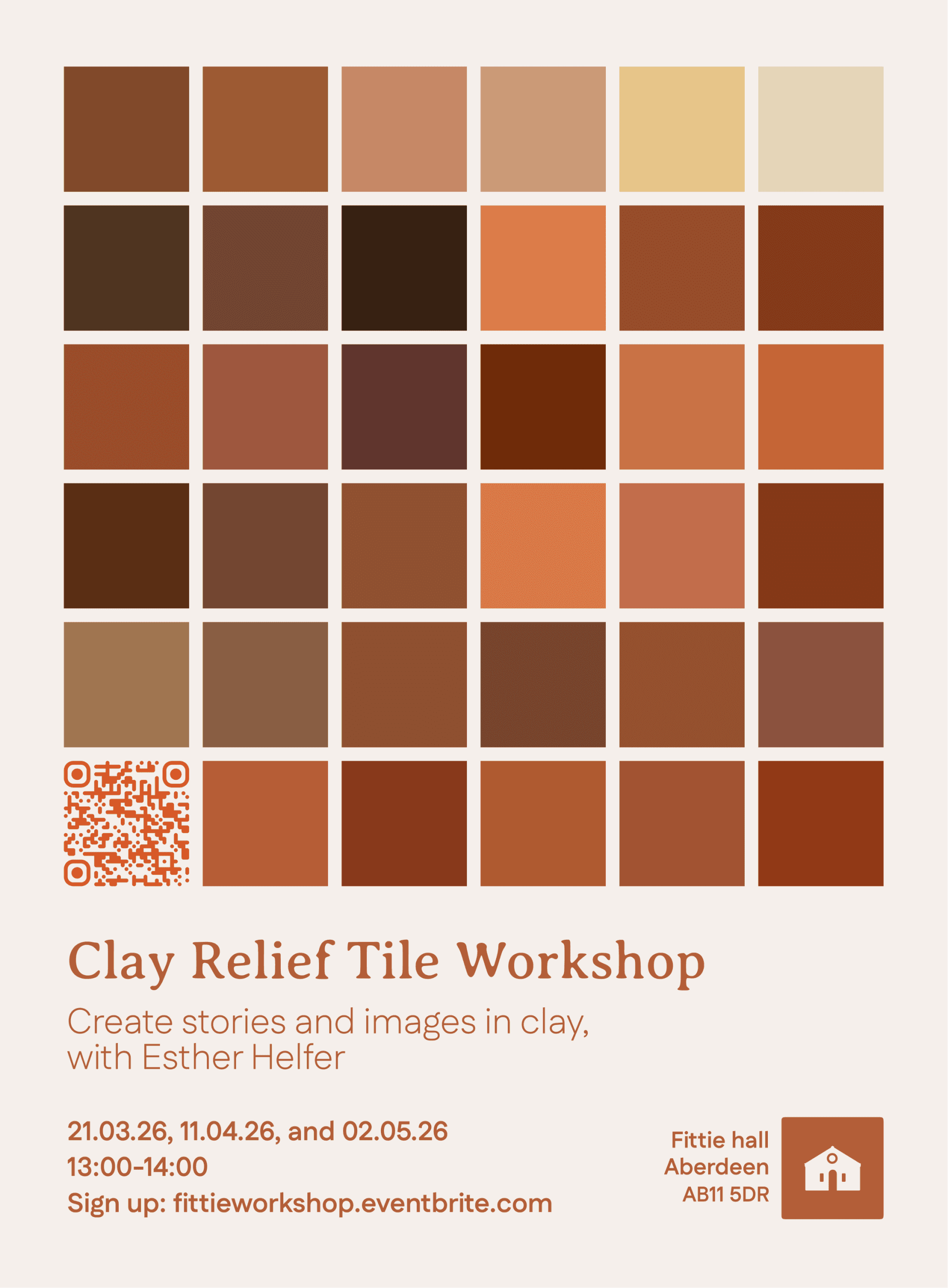
Our exhibition at Fittie Community Hall will feature an interpretative red clay sculpture of the city, alongside works that look both backward and forward in time. I’ll also be running clay relief workshops, carving and layering imagery into clay, amplifying the interplay between illustration and sculpture. We’re inviting people to bring a story or image of Aberdeen to inspire their tile.
Anu: Just as red roofs are peppered across today’s skyline, fragments of history are scattered across the city. We hope the exhibition encourages people to piece those fragments together, to compare past and present and perhaps even imagine what comes next.
We are living in a time of rapid change. What story from the past is important to preserve?
Esther: For me it’s the Parallel Roads of Glen Roy, three horizontal lines etched into the hillside by glaciers during the last Ice Age. They remind us that landscapes move slowly, even when time feels fast.
I find comfort in those ancient traces. They put our human timescales into perspective. Cities change dramatically, only fragments remain, and our understanding of them evolves. The land reminds us of continuity.
Anu: I think we should preserve both material and immaterial stories not just those of remembered figures, but also those overlooked.
Aberdeen’s energy history is one I’d like to see better understood. The city once had three windmills. Then came oil. Now wind turbines, windmills of another kind, rise again. That continuity reframes the narrative. Rather than preserving a single story, we should preserve the layered nature of many stories.
What is on your mind right now?
Anu: We’re getting married on 27 March at Fittie Community Hall. In many ways this project feels like a marker of our lives together.
Esther: It’s our first major collaboration and we hope it’s the beginning of many more. We see the exhibition as a backdrop for conversation about what it means to live in the North East of Scotland and about people’s personal relationships with Aberdeen.
Anubhav: Recently, while walking through Don Side Walled Garden, we met two people who generously shared their knowledge about a dilapidated granite building. That openness stayed with us. We hope the exhibition creates more moments where stories surface and are shared.
Looking three years into the future, what changes would you like to see?
Esther: I’d like to see greater recognition and support for artists and makers in the North of Scotland. Aberdeen is a hub for many industries, but its creative voices deserve equal attention. The art scene here is vibrant and I hope in the coming years it gains broader recognition across Scotland and beyond.
Anu: I hope there are more spaces, in Aberdeen and elsewhere, where people can explore multiple readings of the city’s identity beyond stereotypes.
Through initiatives like Nuart and Spectra, the city already acts as a canvas for local and global narratives. I hope this continues to evolve. On a practical note, I’d love to see longer evening opening hours. Whenever restaurants and cafés stay open later, the city comes alive. It would be wonderful if that energy were less of an exception.
Is there anything else you’d like to share?
Anu: We’d love to invite everyone to our exhibition, opening Friday 27 March at Fittie Community Hall.
Esther will also be running clay workshops in the coming months, encouraging storytelling through handcrafted relief tiles. If you have a story about Aberdeen, we’d love to hear it and perhaps see it shaped in clay
The Red Tile exhibition is on at the Fittie Community Hall, New Pier Road, Aberdeen, AB11 5DR
Exhibition opening 27 March 6pm-9pm.
Then daily 11am – 4pm until Sunday the 5 of April.
Book a place at one of the Clay Relief Tile workshops here:
https://www.eventbrite.co.uk/e/clay-relief-tile-workshop-tickets-1981524214266?aff=oddtdtcreator