


We’ve been talking to… Chris Aldred
“Knitting allows us to be present in spaces that might otherwise feel inaccessible.” Chris Aldred, Knitter and Climate Activist
At Open Road we’re passionate about storytelling and giving people voice. We believe that understanding the past can inspire change in the here and now and help build a better future. We regularly have inspiring conversations with remarkable people through our work who are using storytelling to drive change. Through ‘we’ve been talking to’ we share these conversations, the learning and the inspiration. Let us know if there is anyone we should be talking to.
Tell us about who you are and the work you are currently doing
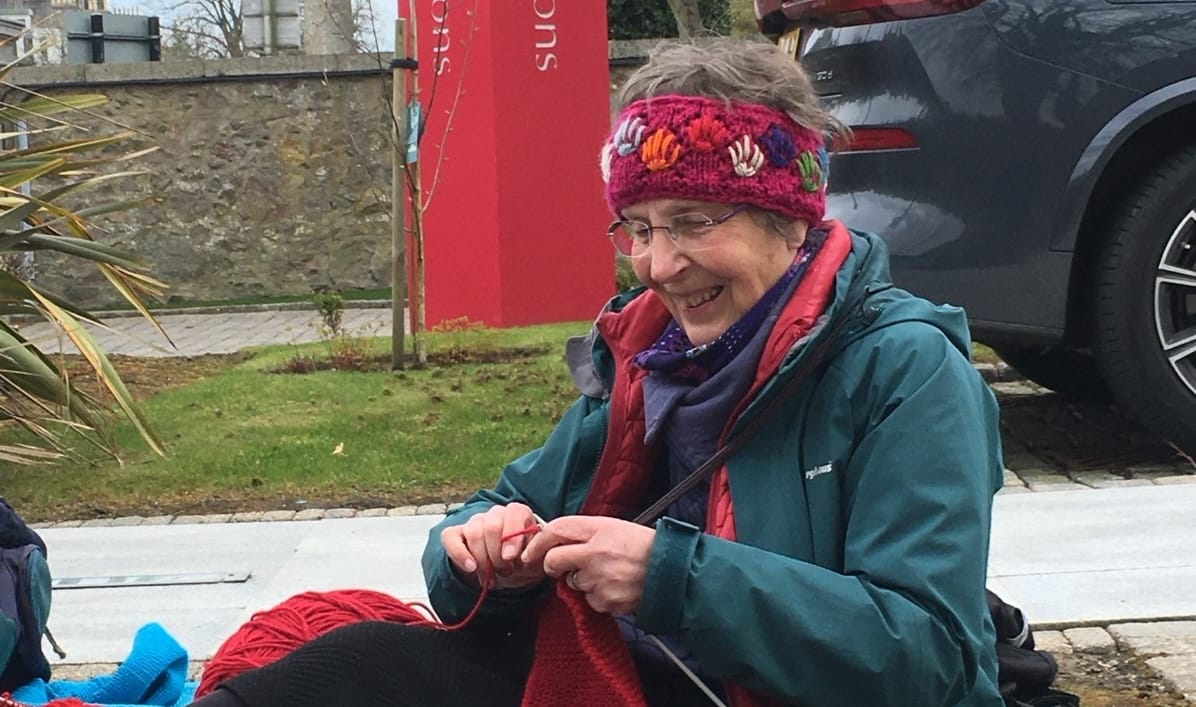
I am part of the North Sea Knitters, a group of women who knit as a form of protest for climate action. I joined the group after meeting a woman on the bus to a St. Fittick’s Park demonstration and soon discovered that we shared a history of protest, along with a belief in women’s craft and art as a way of creating solidarity and building resistance.
There are around ten of us in the core group, mostly “bus pass holders”, with a couple of younger women joining from time to time. We organise as the North Sea Knitters and have a social media presence as #northseaknitters. We have a wider chat called ‘hold the red line’ for supporters and other knitter groups and our Instagram stuff goes on to #knittingforclimate.
Knitting allows us to be present in spaces that might otherwise feel inaccessible. It helps us start conversations and disrupt environments in a quiet, slightly mischievous way rather than through aggression. Much of our focus has been on opposing projects such as the Rosebank oil field and challenging the influence of oil companies on climate policy.
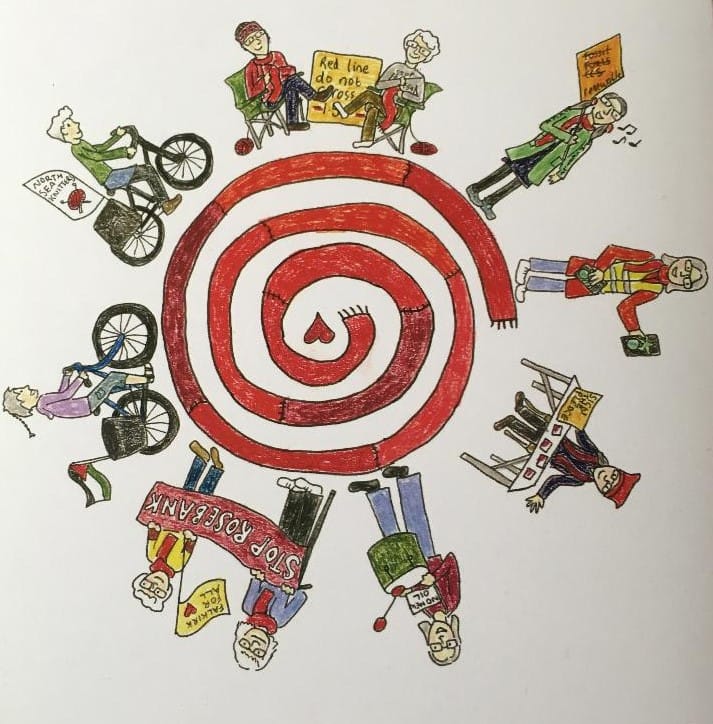
We’ve been inspired by Scandinavian women who wrapped their parliament in a long red scarf, and we put aside our other projects to start knitting red scarves too, as part of a wider international knitting-for-climate movement. We’ve knitted in the garden of the legal firm involved in the Rosebank oil field case, sat knitting in Equinor’s offices when they were unable to explain their policy and taken part in actions against Equinor and Ithaca. We’ve also knitted inside Barclays Bank, usually aiming to disrupt in a mischievous rather than aggressive way and get people talking.
I have always been pro-women, and the kindred spirit I met on the bus of the North Sea Knitters has always been pro-peace. Our significant area of overlap is climate action. Being both pro-peace and pro-woman inevitably means engaging with climate issues, because women are often the ones who bear the brunt of the climate crisis.
We’re living in a time of rapid change. What story from the past do you think it’s important to preserve?
We’re living in a time of rapid change, and I think it’s vital that we don’t lose the story of women’s liberation and feminist struggle. Younger people understandably want to bring their current concerns to the past and see how those issues were previously handled.
What matters is preserving both the world we were rebelling against, where women came home from work to make their husband’s tea and carried out domestic labour that wasn’t even recognised as work, and the world we’re in now, so people can compare the two. It’s about critical thinking, asking, “What in our current environment will seem completely ridiculous in 30 years time?”
It’s easy to look back and see what’s outdated, but much harder to look forward and recognise what will appear just as outdated to future generations. As the pace of change accelerates, holding on to these stories becomes even more important. That’s why archiving women’s liberation and local activism matters. It helps people think critically about both the present and the past.
What’s on your mind right now?
I’m thinking about where to put my own energy and where the knitters should put ours as a group. We don’t all do the same thing, and we don’t expect to.
We recently met in Dundee and what struck me was the sheer range of issues and perspectives people brought from their own areas. We don’t meet often, only when we’re taking action together or for a “knit and natter.” There’s a lot on my mind and on the knitters’ minds too.
There’s a strong worry that the UK Government will give the Rosebank project the go-ahead. People in London are working very hard to keep pressure on Ed Miliband and while we suspect any announcement may be delayed for electoral reasons, we don’t want attention to slip. “No new oil and gas” is very much at the forefront of our thinking.
I’m also deeply concerned about climate targets being pushed back with the suggestion that we can simply “do more later”, when in reality we’ll likely still be burning away by then. I’m troubled by how much climate action is shaped by corporate interests and how little support there is for communities, despite huge goodwill for energy saving schemes and self-managed projects.
Many people are doing good work but can’t scale up in the way corporations can, while government continues to funnel money towards large companies. Working out how we resist this is on my mind, as is the damage currently being done to St. Fittick’s Park.
Looking three years into the future, what changes would you like to see?
I would like to see water companies nationalised. I’d like all subsidies to the oil and gas industry completely removed. I’d like to see communities given far greater influence over their own local finances, including direct funding to spend as they see fit.
Is there anything else you’d like to share?
What keeps me going is a strong sense of injustice, something I inherited from my mother who believed deeply in the principle of “do unto your neighbour as you would be done by.” I’ve had quieter periods and even now I sometimes feel like I’m not “winning” anywhere, but that principle, and the support of others, keeps me acting.
Meeting the North Sea Knitters re-energised someone who had been fairly inactive for a while. When I met them, I thought here are women I can really talk to, women of a similar age who understand my concerns, my history and what it was like protesting in the 1970s. Having people around you who share your concerns and your history makes a huge difference.